Amazon Marketing Cloud (AMC) is Amazon Ads' privacy-safe analytics environment. It links a shopper's ad impressions and clicks to the product views, carts and purchases that follow, across 25 months of history. You use it to answer journey questions and to build audiences for Sponsored Products, Sponsored Brands, Sponsored Display and Amazon DSP.
This guide recaps our November 4, 2026 AMC workshop, led by Jaimin Patel, Founder and CEO of Aakaar AI. It covers the five questions to run before Black Friday, the audiences to build, how to test them, and a ten-week Q4 plan.
Prefer video? Watch the full workshop replay on YouTube.
Key takeaways
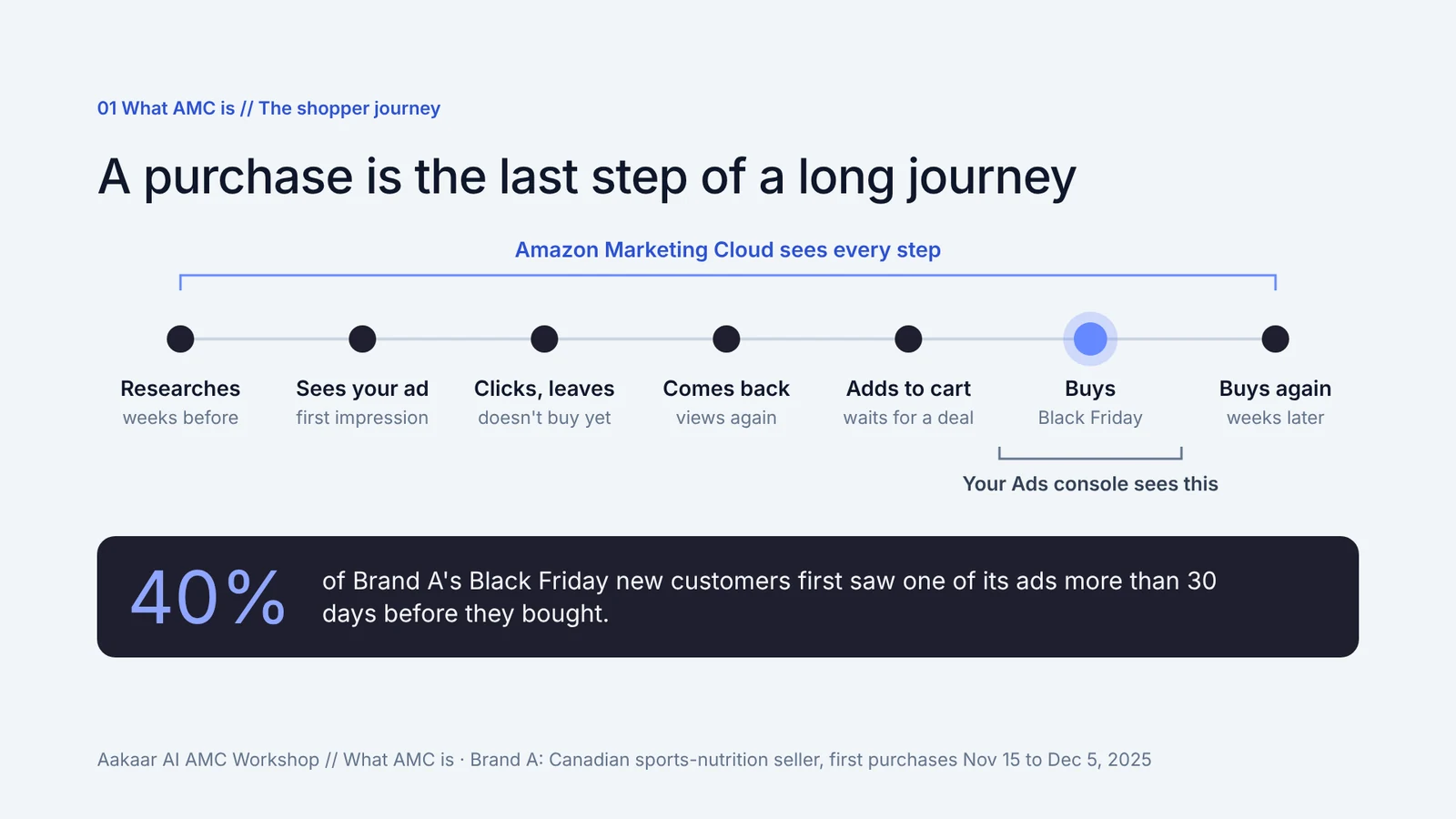
- 40% of one brand's Black Friday 2025 new customers first saw an ad more than 30 days before buying. Last-click reporting gives those early ads no credit, so category campaigns look wasteful when they aren't.
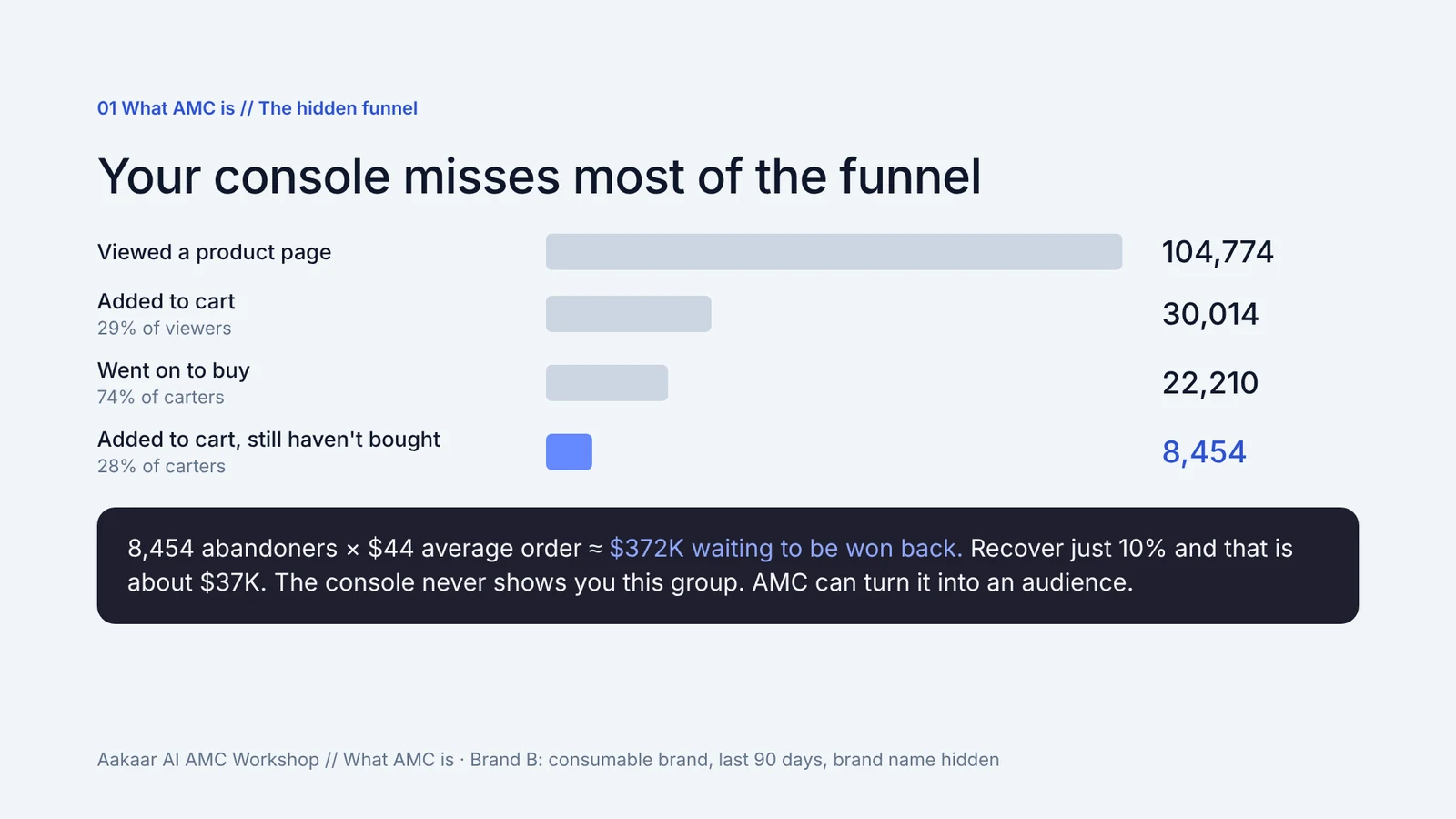
- 8,454 shoppers added to cart and never bought in one brand's last 90 days. At a $44 average order that is about $372K, and winning back 10% is roughly $37K.
- Start every audience test at a +25% bid boost, keep the original campaign as a control, and read results after the 14-day attribution window.
- Black Friday is November 27 and Cyber Monday is November 30, so build audiences now. New audiences can take up to four days to sync.
What does Amazon Marketing Cloud show that the Ads console doesn't?
AMC shows the whole shopper journey, while the Ads console shows totals per campaign and credits the last ad clicked. In sponsored ads you choose where an ad shows: a keyword, a product page or a category. You don't choose the shopper, so a first-time browser, a cart abandoner and a loyal buyer all see the same ad at the same bid.
AMC matches ad events (impressions and clicks) to shopping events (page views, carts and purchases) for the same anonymous shopper. It reports on groups, never individuals. Two things come out: answers about the journey, and audiences you can bid on.
What AMC sees: every ad impression and click, the views, carts and purchases that follow, new versus returning buyers (new-to-brand means no purchase in the last 365 days), and 25 months of history.
What AMC doesn't see: individual shoppers, competitors' sales, Shopify, Google or Meta data unless you upload it, real-time data (it lands 1 to 3 days late), or proof that an ad caused a sale.
Two results from the workshop show why this matters:
- A long journey. For a Canadian sports-nutrition brand (1,546 new customers, November 15 to December 5, 2025), 40% first saw an ad more than 30 days before their first purchase, 24% saw one 1 to 29 days before, and 36% on the same day.
- A hidden funnel. For a consumable brand in its last 90 days, about 105,000 shoppers viewed a product page, 30,014 added to cart and 22,210 bought. The 8,454 who carted and didn't buy are invisible in the console. AMC can turn them into an audience.
Which five Amazon Marketing Cloud questions should you run before Black Friday?
Run these five on last year's Black Friday data. AMC's 25-month lookback puts November 2025 in range. Each question ends in a budget decision or an audience.
The data below comes from two brands with names hidden. Brand A is a Canadian sports-nutrition seller. Brand B is a consumable brand with Subscribe & Save.
| Question | What the data showed | What to do |
|---|---|---|
| Where do my new customers come from? | Brand B, last 90 days: 59% of ad-driven buyers were new to the brand and brought in 51% of ad sales. 92% of new customers came through Sponsored Products. 75% to 83% of buyers from competitor and category targeting were new. | Judge competitor and category campaigns on new customers won, not last-click ROAS. |
| How long before a shopper buys? | Brand A: 40% of Black Friday new customers first saw an ad more than 30 days before buying. | Fund category keywords from early November. Don't cut them on last-click ACOS. |
| Which searches start and finish a journey? | Brand A: 43% of new customers whose first ad touch was a category search started more than a month before buying, against 19% for brand searches. | Budget category and brand terms separately. Shift toward brand terms in Black Friday week. |
| Do shoppers who leave ever come back? | Brand B: 8,454 shoppers added to cart and haven't bought, about $372K at a $44 order. | Build a cart-abandoner audience this week and retarget it from November 16 to December 6. |
| What are repeat buyers worth, and what do they buy next? | Brand B, last 12 months: 18% of buyers drove 48% of revenue, and a 3+ order buyer is worth 5.4 times a one-time buyer. Brand A: 36% of second orders came within 30 days, and 64% were a different product. | Set what you'll pay for a new customer from repeat value. Show new buyers the flavors and sizes they usually pick next. |
Which Amazon Marketing Cloud audiences should you build first?
Start with five. An audience changes who you bid on, while an insight changes where budget goes, so you need both.
| Audience | Who is in it | Lookback | Where it runs | How to start |
|---|---|---|---|---|
| Cart abandoners | Added to cart, didn't buy | 14 to 60 days | Sponsored Products and Sponsored Brands boost, Sponsored Display | +25%, then adjust |
| Clicked, didn't buy | Clicked an ad, didn't buy | 30 to 60 days | Sponsored Products and Sponsored Brands boost, Sponsored Display | +25% on branded and category exact |
| Category searchers | Searched category terms, didn't buy | 14 days | Sponsored Products boost on a copied category campaign | Large boost, lower base bid |
| New-to-brand lookalike | Shoppers like your recent first-time buyers | Seed of 500+ | Sponsored Products and Sponsored Brands boost, Sponsored Display, DSP | Cut base bid, boost the audience |
| Repeat buyers, no Subscribe & Save | 2+ orders, not subscribed | 12 months | Sponsored Display, DSP | Subscribe & Save message |
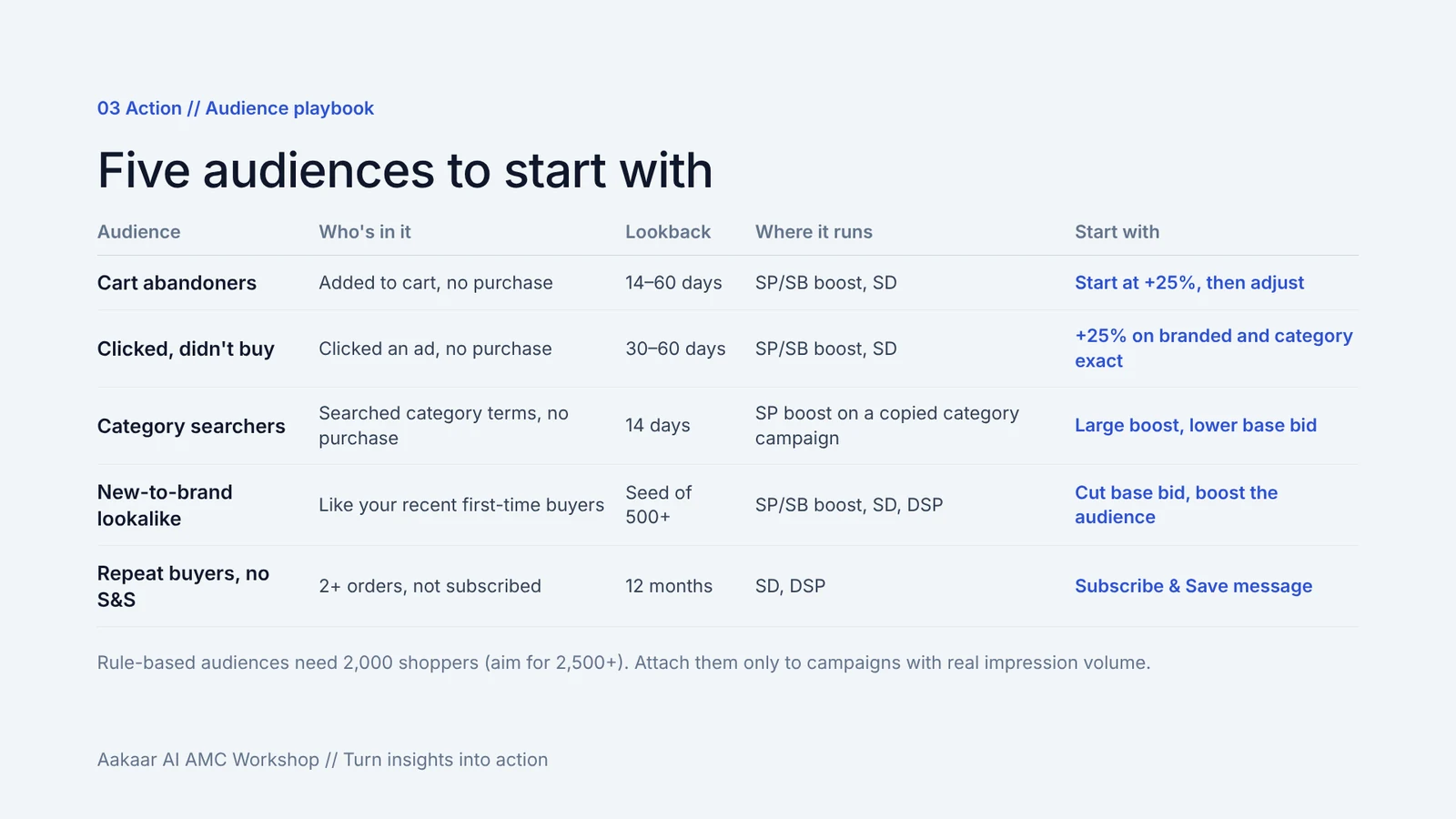
In Sponsored Products and Sponsored Brands an audience works as a bid boost, up to +900%, with one audience per campaign. In Sponsored Display you target the audience directly. Sponsored ads can boost an audience but can't exclude one. Exclusions need DSP.
How do you test an AMC audience in Sponsored Products?
Run it against a control. Copy your campaign so both versions have the same keywords and targets.
- Control: the original campaign, bids unchanged, no audience.
- Test: the copy, with base bids lowered and one AMC audience attached as a bid boost.
- Start retargeting audiences at +25% and change one thing at a time.
- Read the result after the 14-day attribution window.
Judge the test on new-to-brand rate, conversion rate, total brand sales and TACoS, not only the test campaign's ROAS.
How do you measure whether an AMC audience worked?
Treat attribution as evidence, not proof. From weakest to strongest, your options are console ROAS, AMC multi-touch attribution, exposed versus unexposed comparisons, a holdout or switchback test, and a media mix model. AMC gives you better credit for each touch, but only a holdout or switchback test shows what a campaign actually added. Before you act on a result, wait 14 days, match totals to the console, and check for missing rows.
What are the limits of Amazon Marketing Cloud?
Four rules save most beginners a week of confusion:
- Small groups disappear. Rows below a privacy threshold, often about 100 shoppers, are dropped without warning. Start with broad questions.
- Audiences need size. Rule-based audiences need 2,000 shoppers and lookalike seeds need 500. Aim for 2,500 or more, and allow up to four days to sync.
- Attribution needs time. Data lands 1 to 3 days late, so run attribution questions 14 days after the period ends.
- Volume decides value. Under a few hundred ad orders a month, many cuts come back blank. Fix campaigns and listings first.
What is a good Amazon Marketing Cloud plan for Q4 2026?
Use four moves across ten weeks. Black Friday is November 27 and Cyber Monday is November 30, and shopper journeys start weeks earlier, so the plan starts now and runs to January 5.
| Move | When | Where it runs | What to watch |
|---|---|---|---|
| Reach category shoppers | Now to Nov 22 | Sponsored Products phrase and broad category keywords | New-to-brand customers each week |
| Build and retarget the almost-buyer audience | Build by Nov 15, retarget Nov 16 to Dec 6 | AMC audience, Sponsored Display plus a Sponsored Products bid boost | Audience size above 2,500, return rate vs last year |
| Win the brand searches | Nov 16 to Dec 6 | Exact brand and product-name keywords | Conversion and cost per new customer |
| Sell the next flavor or size | Nov 27 to Jan 5 | Sponsored Display to new buyers | Reorders within 30 days vs last year |
Also stock and put deals on the starter products that win first orders, and keep campaigns that open journeys switched on even when last-click ACOS looks weak.
Four steps for this week:
- Run the five questions on last year's Black Friday.
- Build two audiences: almost buyers and a new-to-brand lookalike.
- Copy your top Sponsored Products campaign, attach one audience and start at +25%. Keep the original as the control.
- Fund category keywords now, before deal prices arrive.
Can you use Amazon Marketing Cloud without writing SQL?
Yes. The Aakaar MCP connects your Amazon Ads, AMC, Seller and Vendor Central, and Brand Analytics data to an AI assistant such as Claude or ChatGPT, so you ask in plain English. On its own, AMC means learning the tables, writing and debugging SQL, checking for hidden rows, building the audience by hand and setting it up in each campaign. That is hours per question. With the MCP it takes minutes.
The MCP runs the whole loop:
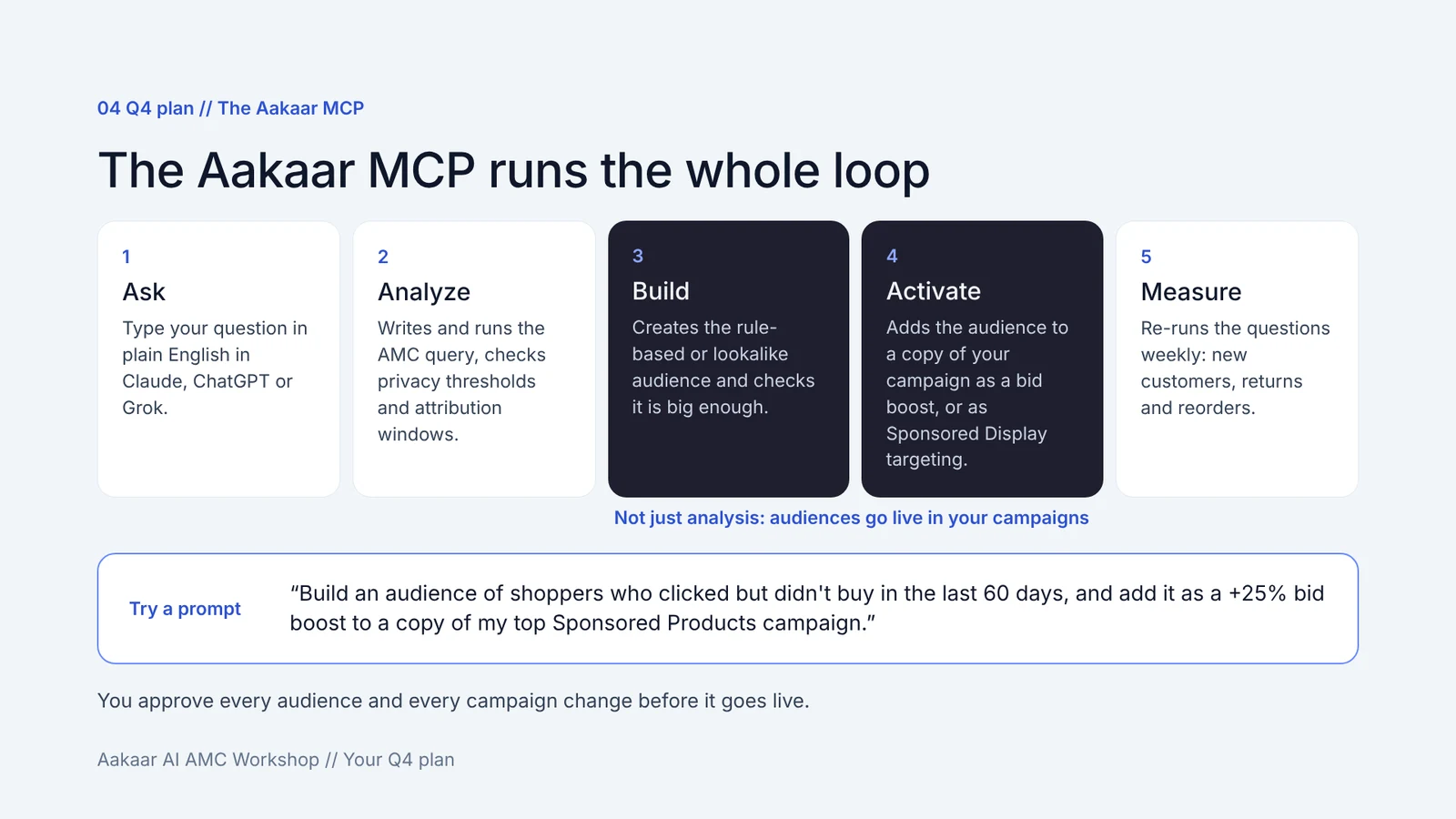
- Ask your question in plain English.
- Analyze: it runs a tested AMC template and checks privacy thresholds and attribution windows.
- Build: it creates the rule-based or lookalike audience and checks it is big enough.
- Activate: once you approve, it adds the audience to a copy of your campaign as a bid boost or as Sponsored Display targeting.
- Measure: it re-runs the questions weekly for new customers, returns and reorders.
It includes 14 ready AMC use-case templates and needs no SQL from you. Example prompt: "Build an audience of shoppers who clicked but didn't buy in the last 60 days, and add it as a +25% bid boost to a copy of my top Sponsored Products campaign." At the end of the workshop, Jaimin ran the five questions live on a real account in a dashboard built by the MCP.
Frequently asked questions about Amazon Marketing Cloud
Get the five AMC workshop prompts
We turned the workshop into five ready-to-use prompts that run on your own AMC data: BFCM Intelligence Brief, New-to-Brand Intelligence, Customer Journey Brief, Retention and LTV, and Audience Activation Plan. Start a free trial to get them in your Aakaar dashboard, or book a demo and we'll walk through your data with you.
Prefer to watch first? Watch the full AMC workshop replay on YouTube. Next up: our free DSP workshop on December 9 at 8 AM PT, Amazon DSP in 2027.
Sources and methodology
- Brand data: Aakaar AI AMC workshop, November 4, 2026. Both brands were queried in AMC through the Aakaar MCP, with brand names and ASINs hidden. Brand A: Canadian sports-nutrition seller, Black Friday 2025 new customers (first purchase November 15 to December 5, 2025), 90-day lookback, repeat orders to October 15, 2026. Brand B: consumable brand with Subscribe & Save, last 90 days for the funnel and new-to-brand figures, last 12 months for repeat buyers. Figures are ad-attributed and from single accounts, so treat them as examples, not benchmarks.
- AMC product details: Amazon Ads, Amazon Marketing Cloud.